Overview dashboard
Use Overview to review sampled traffic, configuration changes and resources that need attention.
Note: Balancer is in beta. Endpoints, fields and behavior may change before general availability, and the feature must be enabled on your account before use. Contact your NetActuate account manager to request access.
Overview dashboard
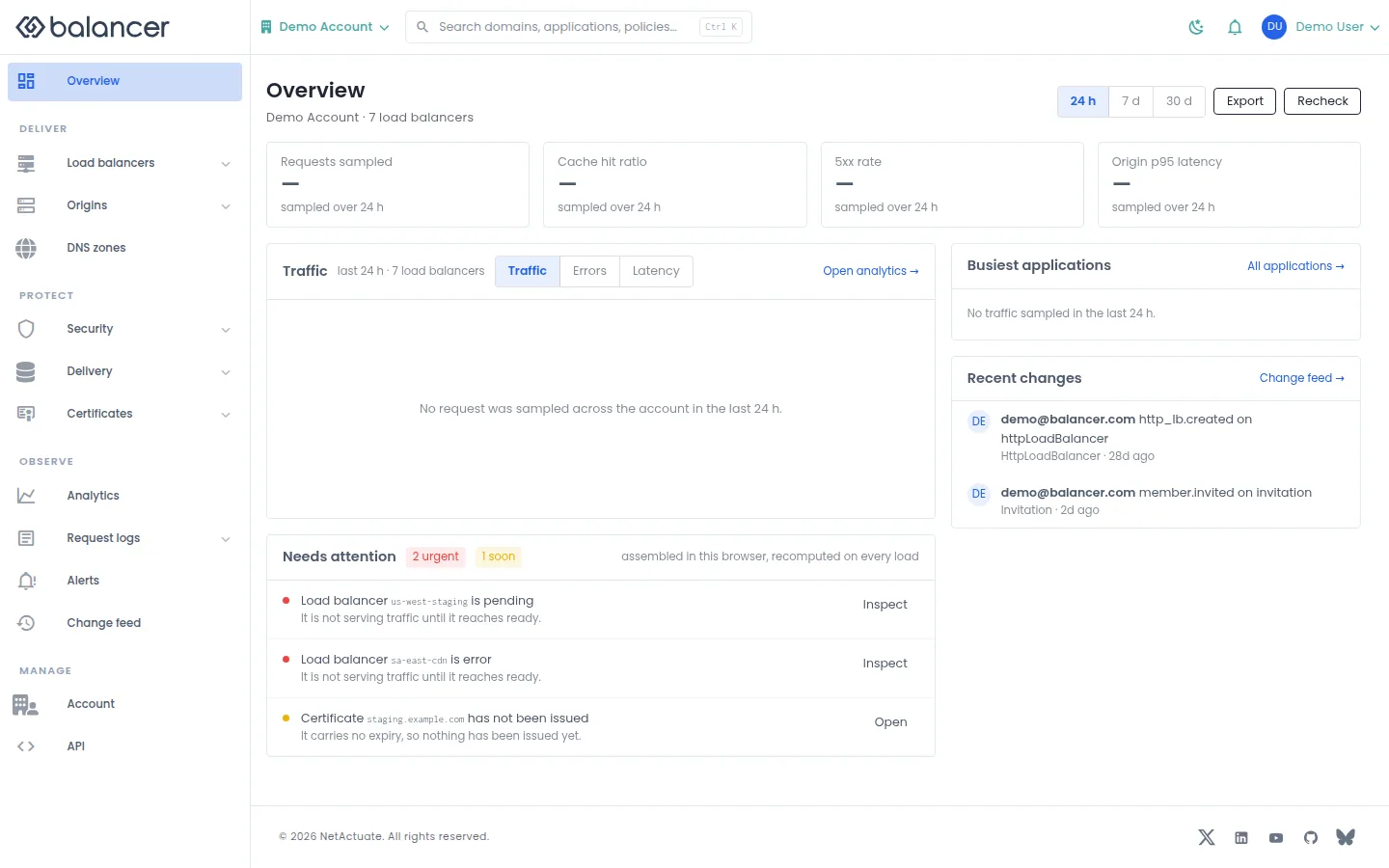
Review sampled traffic, resources that need attention, busy applications and recent changes. Missing measurements are not zero.
- Open Overview.
- Choose 24 h, 7 d or 30 d, then choose Traffic, Errors or Latency.
- Select Recheck to reload the overview. Select Inspect beside an attention item to open its resource.
- Select Export to download the overview, or Open analytics to investigate traffic.
Verify with the API
Use the API host shown in the Balancer portal in place of https://<your-api-host>. Set $BALANCER_API_KEY to your credential for this context.
curl --fail-with-body --silent --show-error --request GET \
  --url "https://<your-api-host>/http-loadbalancers" \
  --header "x-api-key: $BALANCER_API_KEY"
Expect HTTP 200 with code set to 200. The response includes data.meta, data.data[], data.meta.total, data.meta.offset. Compare the returned configuration with the screen. A successful configuration read does not verify that an edge has applied it.
API reference: List HTTP load balancers associated with your account.
Overview dashboard (alternate view 2)
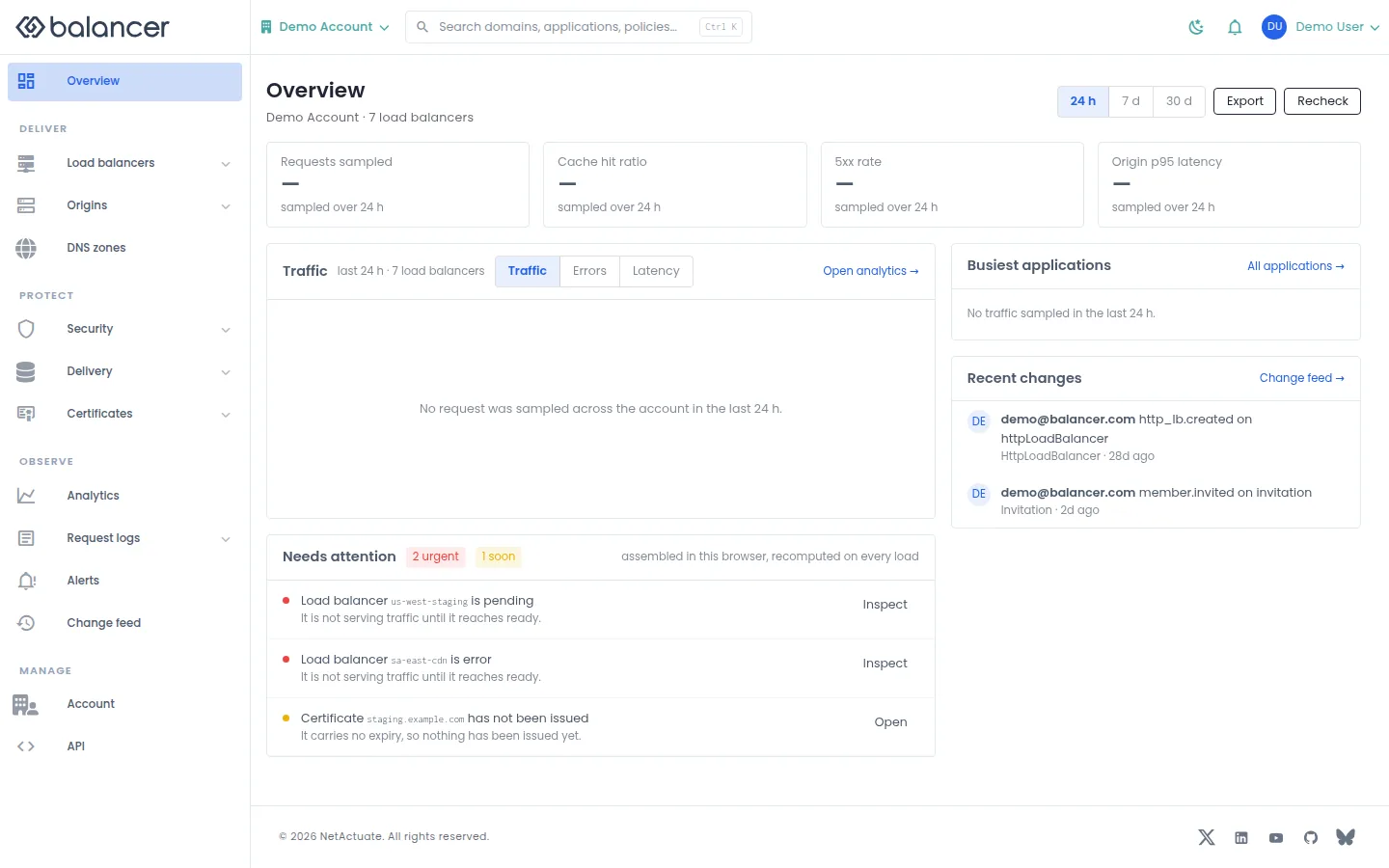
Review sampled traffic, resources that need attention, busy applications and recent changes. Missing measurements are not zero.
- Open Overview.
- Choose 24 h, 7 d or 30 d, then choose Traffic, Errors or Latency.
- Select Recheck to reload the overview. Select Inspect beside an attention item to open its resource.
- Select Export to download the overview, or Open analytics to investigate traffic.
Verify with the API
Use the API host shown in the Balancer portal in place of https://<your-api-host>. Set $BALANCER_API_KEY to your credential for this context.
curl --fail-with-body --silent --show-error --request GET \
  --url "https://<your-api-host>/http-loadbalancers" \
  --header "x-api-key: $BALANCER_API_KEY"
Expect HTTP 200 with code set to 200. The response includes data.meta, data.data[], data.meta.total, data.meta.offset. Compare the returned configuration with the screen. A successful configuration read does not verify that an edge has applied it.
API reference: List HTTP load balancers associated with your account.